
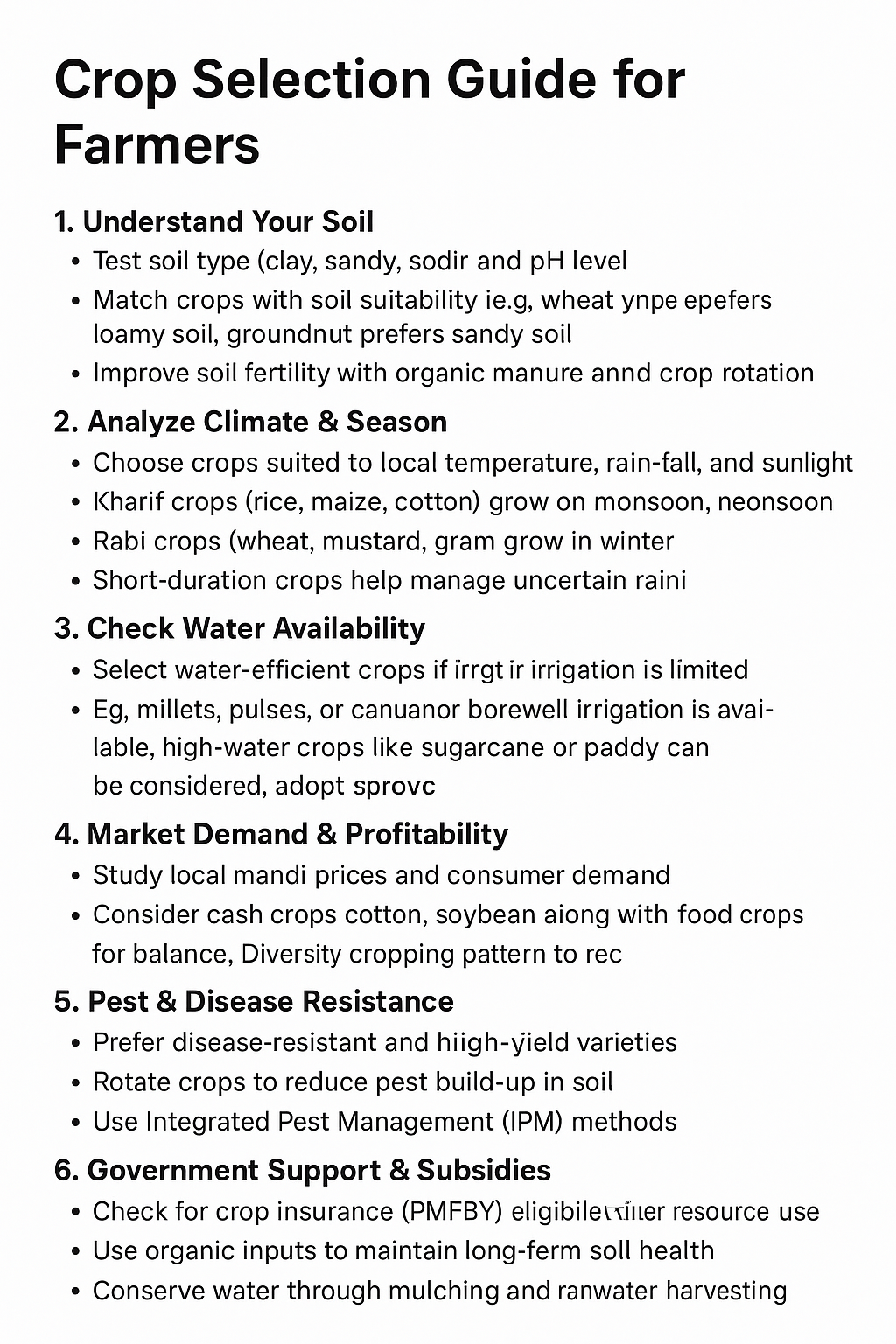
Crop Selection Guide for Farmers
1. Understand Your Soil
- Test soil type (clay, sandy, loamy) and pH level.
- Match crops with soil suitability (e.g., wheat prefers loamy soil, groundnut prefers sandy soil).
- Improve soil fertility with organic manure and crop rotation.
2. Analyze Climate & Season
- Choose crops suited to local temperature, rainfall, and sunlight.
- Kharif crops (rice, maize, cotton) grow in monsoon; Rabi crops (wheat, mustard, gram) grow in winter.
- Short-duration crops help manage uncertain rainfall.
3. Check Water Availability
- Select water-efficient crops if irrigation is limited (e.g., millets, pulses).
- If canal or borewell irrigation is available, high-water crops like sugarcane or paddy can be considered.
- Adopt drip irrigation for water-saving.
4. Market Demand & Profitability
- Study local mandi prices and consumer demand.
- Consider cash crops (cotton, soybean) along with food crops for balance.
- Diversify cropping pattern to reduce risk.
5. Pest & Disease Resistance
- Prefer disease-resistant and high-yield varieties.
- Rotate crops to reduce pest build-up in soil.
- Use Integrated Pest Management (IPM) methods.
6. Government Support & Subsidies
- Check for crop insurance (PMFBY) eligibility.
- Explore government subsidies on seeds, fertilizers, and equipment.
- Choose crops supported under MSP (Minimum Support Price).
7. Sustainable Farming Practices
- Practice intercropping (e.g., maize + pulses) for better resource use.
- Use organic inputs to maintain long-term soil health.
- Conserve water through mulching and rainwater harvesting.
✅ Quick Tips for Farmers
- Don’t rely on a single crop – diversify to reduce financial risk.
- Always prefer certified seeds from reliable sources.
- Plan crops as per market demand, not just tradition.
- Keep records of yield, expenses, and income to evaluate crop profitability.
Leave a Reply